


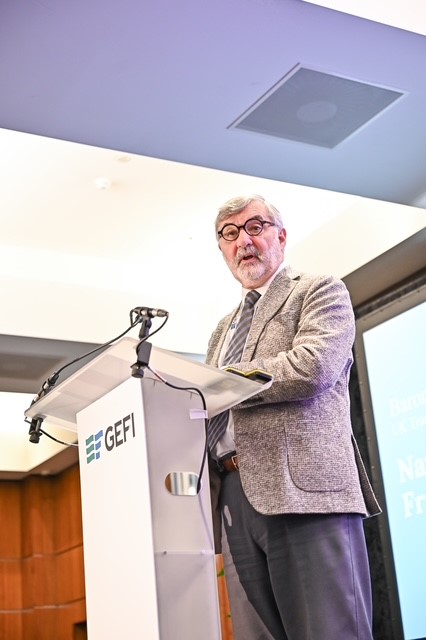
A keynote address by John, Lord Alderdice to the Global Ethical Financial Initiative Summit in Edinburgh on 18 June 2026
This year we mark the 250th anniversary of the declaration by the American colonies of their independence from Britain and also the publication by Adam Smith of ‘The Wealth of Nations’. In Smith’s seminal work he set out what he believed were the key drivers of a nation’s prosperity and argued that wealth comes from productive labour and trade – the activities of its citizens.
The leading lights in the newly independent United States of America also proceeded to set out in the US Constitution of 1787 what they believed were the political and legal requirements of a system of governance that would operate in the best interests of all the citizens of a jurisdiction. Much of the development of constitutional law and socio-economic practice since then has been informed by and based on these seminal models, indeed they came to be thought of as free-standing and in the words of the US Declaration of Independence “self-evident truths.” This perspective was captured by Francis Fukuyama in his well-known essay and subsequent book as ‘the end of history’. He did not mean by this that the world was coming to an end but rather that there was no longer any necessary or credible debate about ideologies because liberal democracy, as understood in America, was now established as the best form of government and social order and social evolution had taken us beyond arguments about what the political good was – all that remained were technocratic debates about what specific policies would best achieve these agreed goals.
However, as Canadian Prime Minister, Mark Carney, pointed out in a speech at the World Economic Forum in Davos in January of this year – one of the most significant speeches by a political leader in the last two decades – this was a delusion that was only able to be maintained by the West ignoring realities that had been widely known by people in what we sometimes refer to as the ‘Global South’. It had also been understood by a minority of Western thinkers such as the Irish economist, Brian Arthur, and the English philosopher, John Gray. The illusion could only be sustained so long as the West was able to maintain military, economic, political and cultural hegemony.
It is often forgotten that when Adam Smith set out his economic model in ‘The Wealth of Nations’, it had been preceded by and assumed the ethical understandings he had previously described in ’The Theory of Moral Sentiments’ published in 1759. Similarly, those who fashioned the US constitution had very clear assumptions informed by their religious and moral backgrounds, and they assumed that the understandings they had were not merely theoretical constructs but lasting universal verities.
This was manifested much more recently in the Universal Declaration of Human Rights which set out how a recognition and observation of the rights of individuals was a necessary and largely sufficient social code for all communities and I well remember the arguments when Singapore’s founding Prime Minister, Lee Kwan Yew, talked of Asian values as being distinctive from those of the West. Surely, it was said, human rights were the same the world over because they were after all ‘human rights’. But what Lee Kwan Yew was pointing out was what was also observed by the philosopher, Isaiah Berlin – that there is not actually universal agreement on what is ‘the good’, for example, as regards the balance of considerations between the rights of the individual and the requirements of the wider society.
As hyper-individualism increasingly dominated thinking in American society, and a rising China with a very different historico-cultural experience was no longer prepared to accept the hegemony of a different set of Western ideas about how society should be organised, the splits between these perspectives began to open up and other differing perspectives also took the stage. The consequence was that the intellectual, political and economic world that Fukuyama had assumed was following a single trajectory and outcome, instead became fragmented.
In addition, the persuasive power of the Western belief in self-organising markets began to evaporate and this was dramatically demonstrated when the former Federal Reserve Chairman, Alan Greenspan, admitted to a Congressional hearing in October 2008 that the economic model that had guided his thinking throughout his life as a central banker was fundamentally mistaken. He acknowledged that he had been wrong to believe that banks and organizations would self-regulate to protect their own shareholders. This had been a fundamental plank in the ideology of free-market economics as it had been practiced in recent times.
But this was not the only Western illusion that was punctured as we moved further into the new century. Tony Blair and his Third Way colleagues were convinced that if China could be persuaded to adopt a market economy it would inevitably also move to develop a liberal democracy. It has subsequently become clear that this too was an error of judgement based on the notion that there is a universal and demonstrably correct, one might even say ‘scientific’ model of the economy and a universal set of values and political and social principles. It is further assumed that these are also individualistic principles on the Western model, and that eventually all cultures would come to accept this. However not only have others not accepted them, but the exposure of the mistaken nature of these assumptions has been followed by the dramatic and increasingly horrifying collapse of the moral order represented by a hegemonic America which has been cut adrift from any sense of the ethical boundaries and moral foundations that were essential assumptions in the minds of both Adam Smith and the drafters of the US Declaration of Independence and Constitution.
The consequence has been a loss of trust and confidence by our citizens that those charged with leadership in politics, economics, governance and social order are honest, know what they are talking about, or have the best interests of the larger citizenry at heart. However all is not yet lost and for me one of the few positive features of this otherwise increasingly dangerous global disorder has been the repeated interventions by Pope Leo, the speeches by King Charles in his recent State Visit to the United States and Mark Carney’s speeches and actions as not only the Prime Minister of Canada but increasingly as the political thinker and leader who most clearly represents genuinely liberal democratic politics and values. Indeed ’Values’, with the strapline ‘Building a Better World for All’ – was the title he chose for his major work – published in 2021 building on his experience in business and banking but prior to his involvement in elected politics. What all three of them bring to the table and reflect in their speeches and writings is a clear personal moral framework and an appreciation that others may have a different framework that must be treated with respect even if we do not entirely share it.
These two elements are crucial – having a clear personal moral foundation, and having also a respect for, and relationships with, those who hold to a different set of views. Holding both together was, for the philosopher, Isaiah Berlin, one of the features that differentiated pluralism from multi-culturalism. In Value Pluralism, as it has come to be called, we hold to our own foundational moral values but have a relationship of respect with those who differ, and it is this combination that has been lacking in much of our political and intellectual leadership. In my view it is this ‘value pluralism’ that we must espouse if we are not to continue our slide into a third catastrophic and potentially existential global conflict.
It is also important to emphasise that our differences are not just about economic policy. It is not just “the economy, stupid” as maintained by Bill Clinton’s political strategist, James Carville. Indeed, left and right economic differences are no longer the primary dividing line. The deeper divisions are on attitudes to culture and identity, and while these are exacerbated when there is economic hardship, they also result from war, rapid, large-scale poorly managed migration, pandemic disease, and other disruptions to cultural stability without society having time to accommodate to them.
Adopting a posture of ‘value pluralism’ can allow us to have our differences without a resulting fragmentation if we can sustain our relationships despite our differences – and that requires more than structures and regulations; it requires emotional attachment – a human dimension of sustained relationships that is beyond anything that can be provided by Artificial Intelligence.

1 Comment
Thank you John Alderdice, reminding us that at our core we are all human first and foremost and therefore relational creatures, relying on trust, communication and curiosity to understand others. This brings hope.