


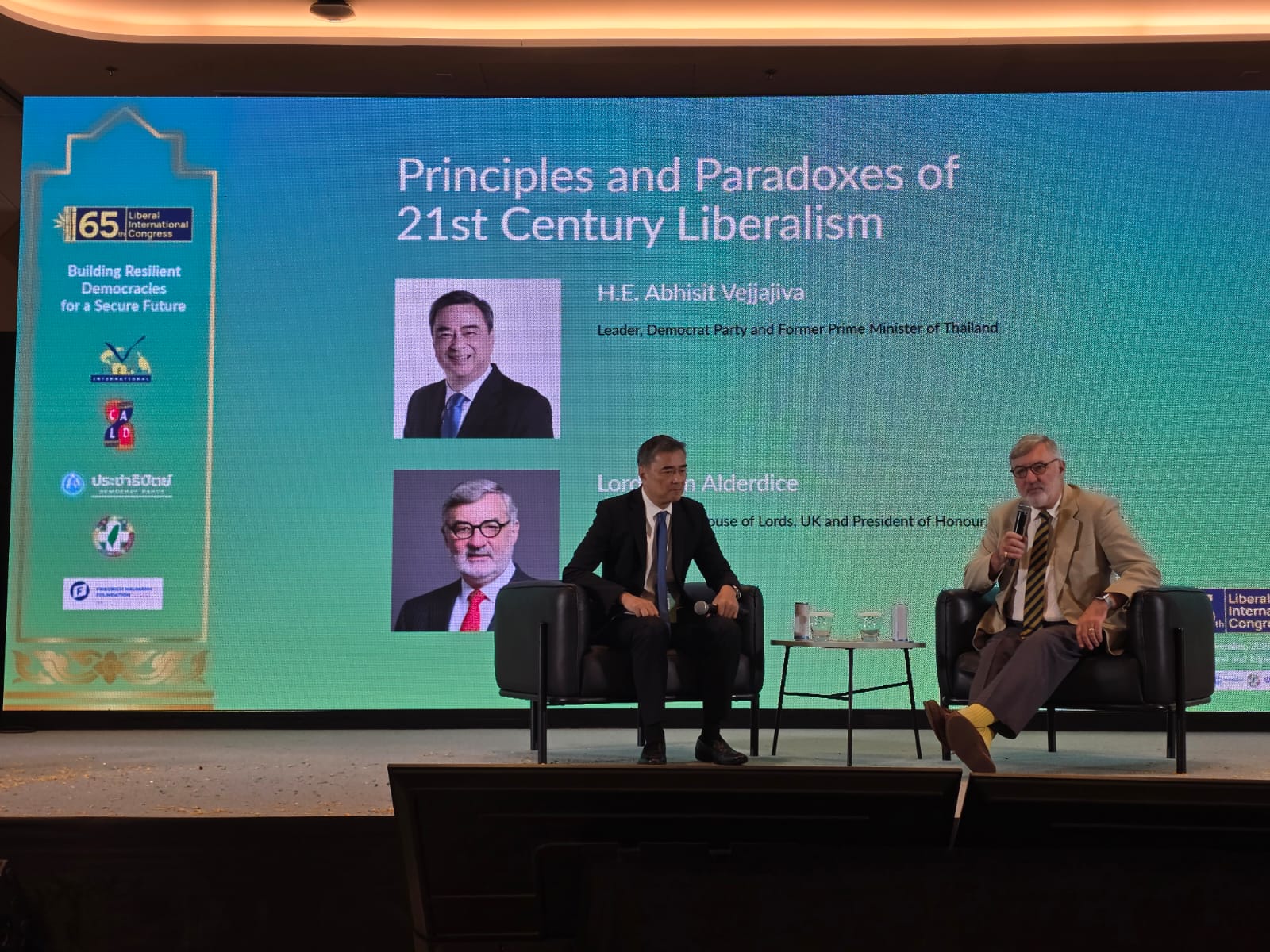
Lord Alderdice’s contributions to his dialogue with HE Abhisit Vejjajiva , Leader of the Democrat Party and former Prime Minister of Thailand, at the 2026 Liberal International Congress in Bangkok on 2 November 2026, were based on the script that follows –
This year marks the 250th anniversary of two significant liberal events – the publication of The Wealth of Nations by Adam Smith and the adoption of the Declaration of Independence of the United States of America, signed on July 4, 1776. But both historic developments show how even the best initiatives can be tarnished by history when, as is frequently the case, only a part of their message is observed.
In the case of Adam Smith’s landmark book, it is often forgotten that he had previously published The Theory of Moral Sentiments and his economic theories were built on ethical principles that he regarded as foundational. In particular, he showed a profound concern for fairness and the well-being of others. As David Pitt-Watson the eminent Scottish thinker and practitioner on responsible investment points out, Adam Smith insisted that justice must sit at the heart of any effective economic system. In the Theory of Moral Sentiments, Smith pointed out that, “If justice is removed the great, the immense fabric of human society…must in a moment crumble into atoms.” If we are to look for why our global rules-based order is dissolving, we should be aware of how many people, and not only in what we call the ‘global south’ feel the profound absence of a sense of justice in our global economic system.
In the immediate post-war era, the United States was accepted by the rest of the Western world as the global hegemon precisely because they thought that she had both the power and the commitment to maintain a rules-based international order. However, when America gradually, and then precipitously, abandoned any sense of the crucial role of ethics and morality in business and politics, there was an inevitable and calamitous worsening of international relations, and that link between ethical failure and international crisis was spelt out by our liberal colleague, the Canadian Prime Minister, Mark Carney in his landmark speech at Davos in February of this year.
We have been asked today to consider what liberalism means in a world that is so profoundly different from the one in which Liberal International was founded 80 years ago at Wadham College on 21 November 1946 and then officially constituted with the adoption of the Oxford Manifesto in April 1947. In this era of democratic uncertainty, geopolitical fragmentation, technological transformation and competing ideas of identity and belonging, we liberals are challenged to maintain, implement, and build upon our enduring principles in the context of contemporary domestic and geo-politics. How are freedom, democracy, pluralism, and human dignity to be understood and defended in the twenty-first century? As we confront these profound, some might say existential challenges to our beliefs and the societies in which we wish to live, what must we reconsider, revise or renew to remain relevant to the present and future generations?
It is easy and tempting to simply blame others for the parlous state of our global society and the falling away in support for both liberalism and liberal democracy. In recent years there has been a serious deterioration in global peacefulness, as evidenced by the 2025 Global Peace Index (GPI) published by the Institute for Economics and Peace. My friend, Steve Killilea, and his IEP colleagues have been monitoring and publishing objective measures of the level of peacefulness around the world for nearly two decades and that 19th report covers 163 independent states and territories containing some 99.7% of the world’s population and rating their various levels of peacefulness. The GPI is now the world’s leading measure of global peacefulness and for the sixth year in a row that measure has deteriorated. The average country score on the GPI has also deteriorated for 13 of the last 17 years and has not improved on average in any year since the 2013 GPI. This means that the deterioration in global peacefulness is measurable, continuous, and deeply worrying, not only because of the prospect of the ongoing and increasingly global conflict, but because the Global Peace Index monitors societal measures that we would regard as measures of liberal democracy. Every year we are seeing fewer countries living out the reality of liberal democracy, and more young people becoming disillusioned so that they no longer regard liberal democracy as a practical or even laudable ambition for their societies.
We must ask ourselves why this is so, and I believe that an important element lies in liberals letting go of some of our own historic commitments and strengths.
The British liberal journalist, Edward Luce, wrote last year in the Financial Times, that beyond the internal divisions, contemporary Western liberalism has two major character defects that augur badly for its resurgence. The first is lack of conviction. “It is all very well, he said, “pointing out the dangers of Trump, Farage, Le Pen and others. It would be negligent not to. But making the negative case is not enough. Saying, ‘I might not be beautiful, but have you seen that ugly person next to me?’ is not a winning sentiment. We must make the positive case. But he then pointed out that Western liberalism’s second defect is intolerance of difference and this, along with a development of hyper-individualism and loss of the sense of the centrality of relationships with others as communities, is perhaps even more central, for it was the protection of minorities from the abuse of power that was the origin of the development of political liberalism, first in Britain in the 17th century, and then elsewhere. The driver was not just the importance of individual rights but the protection of communities that were abused, unequally treated and discriminated against that was central. In those days it was dissenting religious minorities that were treated badly by the established church and government, and we would like to believe that we still stand on the side of minorities that need protection. But we need to be aware that often those who experienced historic discrimination can themselves become oppressive when they acquire powerful positions. As the great British Liberal, Conrad Russell observed, even liberals who have stood for concern about oppressed minorities can themselves become the intolerant oppressors of the next generation and we see that displayed in a quite horrifying way in Israel/Palestine. We can also be very partial in our concerns and when, for example, others look at the difference between our stance in defence of Ukraine against Russian aggression, but equivocate about the unforgivable treatment of ordinary Palestinian people by the Israeli authorities, and ignore almost completely the conflicts and suffering in sub-Saharan Africa, we are seen not as the upholders of justice and the rule of law but as partial and hypocritical in our professed concerns. The Earl Russell also pointed out that when it comes to the principle of equality before the law, we are often better at proclaiming it than implementing it, even within our own political structures – look, for example, at the representation of women and people of colour within the leadership structures of Liberal International.
In our search for success, we need not just good ideas but also good techniques of political campaigning, however we must also be aware that when the techniques of campaigning overtake in importance the cause for which we are campaigning, we may simply be inventing techniques that our opponents can use to greater effect because of their greater financial resources and their preparedness to use them without legal let or moral hindrance.
The importance of maintaining both our principles and how we campaign for their implementation takes me back to how essential it is to hold on to all aspects of our political creed. As liberals we are of course committed to liberty, and, as Isaiah Berlin pointed out it is often more about positive liberty – ‘freedom to’ – rather than the ‘freedom from’ of negative liberty. But it is not just liberty, we must also remember that liberalism is also about liberality – not just freedom, but also generosity of spirit. And not just freedom, but also fairness – we want free competition, but we also want it to be fair, and so we are concerned about monopolies of all kinds economic, religious and political. However we must also recognize that that some services cannot be provided by individuals on their own – water, sewage, transport, certain aspects of education and health cannot be provided for by individuals on their own and the alternative to a public monopoly may be a private monopoly or total anarchy. Liberals have therefore been less concerned historically about holding to dogma, than to ensuring that the outcome is one of freedom but also fairness for individuals and communities. This is especially a challenge for us today since, while the maintenance of fairness in the governmental and political space remains a constant, and in some cases, increasing challenge, we must pay increasing attention now to the development of extreme inequalities of power and wealth by international corporations that cannot be managed by national governments.
Liberal internationalism developed first in Gladstone’s time and was initially not a vote winner but a point of principle, that may have arisen because the British state was itself a coming together of four nations – England and Wales, and then Scotland and finally Ireland. Whether nationally or internationally the fundamental liberal principle was that of ‘governing with consent’ and the consent of the people in different cultural and historical contexts will require different policy solutions. The same liberal principles implemented in different contexts may require and result in different and even conflicting policies.
That takes me to another, perhaps the central and key principle of the liberalism of Isaiah Berlin – that of value pluralism – and for this I return to the increasing intolerance of many Western Liberals. Impatient to see their preferred policies implemented, and convinced, sometimes rather arrogantly convinced of the rightness of their stance, liberals can become intolerant of difference, but as Berlin pointed out, if you are intolerant of the perspectives of others when you have the political wind at your back, you have little cause for complaint if they are intolerant of your perspectives and principles when they are in the ascendant. Furthermore, your intolerance may stimulate exactly the opposite outcome from the one that you want to see.
This pluralism does not just apply to policies but also to governance and in a world where there are an increasing number of conflicting major state powers as well as monolithic and monopolistic companies exercising unaccountable power in politics, economics, or our environment, we must champion the growth of multilateralism and plural centres of power with all the complexity that involves – for good and ill – and we must also address the seemingly insoluble problem of enforcement at an international level. This enforcement may actually have a better chance to emerge if we focus on developing an international ‘culture of lawfulness’ rather than just an international ‘rule of law’. The principle and practice of ‘live and let live’ is central to liberalism but is not always one of our strengths when it comes to implementation and tolerance of difference.
We liberals may not currently have as much power as previously, but we must ask ourselves how far we may have contributed to this by our not being as good trustees as we might have been. Did we always fulfil the responsibility of the trustee, which is not to use our power or influence for our own benefit by to fulfil our responsibility to hand on that which is entrusted to us in as good shape as possible to the next generation? This is true when the sphere of operation of economic power is global while that of political power is more largely national. Indeed, the power of politicians does not so largely operate on the stage where economic power is exerted. That is why liberals should be so glad to have Mark Carney, someone who understands global economic forces, with his experience as the former head of the Bank of Canada and then of the Bank of England, now elected as Prime Minister of Canada. This is a deeply liberal country which is a member of the G7, a liberal democracy, and a member of NATO and we have asked Bob Rae, one of Canada’s most distinguished politicians and public servants to deliver this year’s Isaiah Beriln Lecture in London on 7th December to help us explore liberal answers after what his colleague Mark Carney called, ‘the rupture’ in the world order. It interests me that when liberals previously had a man with such substantial economic credentials as Mark Carney in a position of global influence before at a time of change, it was John Maynard Keynes in the inter-war years. He proposed that in the establishment of the Bretton Woods agreement there should be an independent international reserve currency and a far grander and more independent IMF than the one that was eventually created. The acceptance of the US dollar as the global reserve currency was a serious post-war failure of liberalism, and removing the US dollar from being the global reserve currency is something that Carney championed when he was the head of the Bank of England. It is something that LI should think about adopting as a policy and is one of many considerations that I hope we will explore, not only in the rest of this Congress, but in the project that LI Headquarters staff and others are putting in place for us to focus again on liberal thought, as I have tried to do in this contribution.
I have not yet touched upon the environment or on arms control and peacebuilding which have become central features of our liberal concerns, but I hope that I have enthused you sufficiently for you to recognize that in so far as the world is sliding away from a liberal agenda, it is not because of a failure of our liberal principles when they were implemented, but because sometimes, we ourselves have only paid attention to one side of our own story, or have failed to practice what we preached, and while we cannot legislate for what others may do, we can pay more attention to ensuring that we recommit ourselves to upholding and implementing our own liberal principles in a time of dramatic and frightening uncertainty and change across the world.
